“When the power of God testifies as to what is truth, that truth is to stand forever as the truth. No aftersuppositions, contrary to the light God has given are to be entertained. Men will arise with interpretations of Scripture which are to them truth, but which are not truth. The truth for this time, God has given us as a foundation for our faith. He Himself has taught us what is truth. One will arise, and still another, with new light which contradicts the light that God has given under the demonstration of His Holy Spirit.
A few are still alive who passed through the experience gained in the establishment of this truth. God has graciously spared their lives to repeat and repeat till the close of their lives, the experience through which they passed even as did John the apostle till the very close of his life. And the standard-bearers who have fallen in death, are to speak through the reprinting of their writings. I am instructed that thus their voices are to be heard. They are to bear their testimony as to what constitutes the truth for this time.
We are not to receive the words of those who come with a message that contradicts the special points of our faith. They gather together a mass of Scripture, and pile it as proof around their asserted theories. This has been done over and over again during the past fifty years. And while the Scriptures are God’s word, and are to be respected, the application of them, if such application moves one pillar from the foundation that God has sustained these fifty years, is a great mistake. He who makes such an application knows not the wonderful demonstration of the Holy Spirit that gave power and force to the past messages that have come to the people of God.”– Preach the Word, p. 5. (1905.)
In his youth James White was a
school teacher. He later became a Christian minister in Maine. He accepted
William Miller’s views on the second advent and was successful in preaching
the doctrine of the soon coming of the Savior. He was a talented and
capable missionary leader, and powerful public evangelist. Not only did he
participate with William Miller, Joseph Bates, and scores of other preachers
in announcing the advent of our Lord near in the 1840’s, but he outlived the
Millerite movement to become the first great proneer of the Seventh-day
Adventist cause.
He died August 6, 1881, when he was only sixty. He literally worked himself
to death. The brethren leaned on him so heavily that his towering figure
fell. His sixty years of life were spent unselfishly and sacrificially. No
other Seventh-day Adventist minister did more than he to build high
principle and efficiency into the life the Advent movement.
Ellet Joseph Waggoner was born on
January 12, 1855, in Baraboo, Wisconsin, and was the sixth child of Joseph
Harvey and Maryetta Hall Waggoner. His father had joined the Adventist cause
in 1852 and was a leading Seventh-day Adventist preacher and writer..
E. J. Waggoner attended the Battle Creek College in Michigan, earliest
Seventh-day Adventist educational institution.
Later, he graduated as a physician from Bellevue Medical College in New York
City. For some time he served on the staff of Battle Creek Sanitarium.
At the 1888 General Conference
session in Minneapolis, Minnesota, he and Jones gave their famous series of
sermons on righteousness by faith. Mrs. White declared about his message, "I
see the beauty of truth in the presentation of the righteousness of Christ
in relation to the law as the doctor (Dr. Waggoner) has placed it before
us." MS 15, 1888.
E. J. Waggoner died on May 28, 1916
at the age of 61. The funeral service was conducted in the Battle Creek
Tabernacle and the sermon was preached by his old friend, A. T. Jones
At age 20, A. T. Jones began three
years of service in the Army. Interestingly enough, he spent much of his
time pouring over large historical works, SDA publications, and the Bible.
He was baptized when he left the Army, and began preaching on the West
Coast. In May, 1885, he became editor of the Signs of the Times, and
was later joined by E. J. Waggoner.
In 1888, these two men stirred the
General Conference session in Minneapolis with their preaching on
righteousness by faith. For several years thereafter, they preached on that
subject from coast to coast. Ellen White accompanied them on many occasions.
She saw in Jones’ presentations of "the precious subject of faith and the
righteousness of Christ…a flood of light" (EGW 1888 Materials, p. 291).
In 1889, with J. O. Corliss, he spoke against a bill in the U.S. Congress on
Sunday observance; the bill was defeated. Thereafter he was a prominent
speaker for religious freedom, serving as editor of the forerunner of the Liberty magazine.
After being president of the
California Conference (1901-1903), he joined Dr. J. H. Kellogg’s staff
against the counsel of E. G. White, a move which after a series of
unfortunate misunderstandings and unwise choices, led to his separation from
denominational employment and loss of church membership.
Jones remained a Sabbath observer
and loyal to most of the other doctrines of the church. He is remembered
especially for his part in bringing into prominence the doctrine of
justification by faith.
In December 1852, Uriah Smith
accepted the message taught by the Sabbath-keeping Adventist and soon was
associated with the publishing interests of the believers in Rochester, New
York. For about a half century he was the editor or on the editorial staff
of the church paper, the Review and Herald. He also served as an
administrator and as a college professor.
J. N. Loughborough became a
Sabbath-keeping Adventist through the labors of J. N. Andrews. He began
preaching immediately and was ordained in 1854. He, along with D. T. Bordeau,
were our first missionaries, sent to California in 1868. In 1878, he was
sent to Europe.
Like most of the early Advent leaders, Loughborough took a real interest in
the literature work. He and James White discussed ways and means of
advancing the work of the gospel. It was suggested that if books were
offered to the public in connection with preaching services, the people
would be willing to pay a small price for them. Thus, the way would be
prepared for more literature to be produced. Young Loughborough tried this
method, and it was a success.
Loughborough was truly a great
pioneer, lending his many talents to the development of the work wherever
there was a need. Loughborough spent his last years in the St. Helena
Sanitarium, where he passed away peacefully on April 7, 1924, at the ripe
old age of ninety-two.
At age 15, Joseph Bates "shipped" on a commercial vessel. For the next
twenty-one years he lived the life of a sailor and ship captain. He returned
to civilian life in 1828 with a small fortune. During the Advent Awakening,
the retired sea captain became a respected evangelist and spiritual leader
among the Adventists.
In early 1845, Bates was
providentially led to an understanding of the truth concerning the
seventh-day Sabbath, and in 1846 he published a 48-page tract on the
subject. The respected Captain was the oldest member of our church pioneers,
and he became the first Seventh-day Adventist local conference president
(Michigan, 1861).
He lived to the age of 80. One
reason for his physical endurance, in spite of many sacrifices, was his
simple diet and temperate habits. He organized of the first temperance
societies in the United States. Bates was a spiritual man with clear-cut
views and the courage of a lion. He did not hesitate to sacrifice when the
need arose. Let us thank God for the venerable Captain — apostle of the
Sabbath truth.
John Nevins Andrews (1829-1883)
became a minister at the age of 21. He claimed the ability to reproduce the
entire New Testament from memory. He could read the Bible in seven different
languages. J. N. Andrews was an intellectual who enjoyed "severe
study" much more than physical activity. He was closely associated with
James & Ellen White in the leadership and evangelistic work of the SDA
Church. As a theologian, Andrews made great strides in the development of
church doctrines. He applied the two-horned beast of Rev. 13 to the United
States of America. In 1855, after thorough investigation, Andrews adopted
sunset Friday evening as the beginning of the Sabbath. This began a standard
for the church. During the Civil War, Andrews lobbied for non-combatant
designation for SDA draftees.
In 1860, he was involved in the
organization of the denominational publishing house. He also published his
extensive research, History of the Sabbath & the First Day of the Week.
This was a work reviewing the seventh-day Sabbath in history. Between
1869-70, he was the editor of the Review and Herald. In 1874, he
became the first SDA missionary in Switzerland. He worked to gather the
scattered Sabbath-keeping companies and organize them with a united message.
While living in Basel, he contracted tuberculosis and died. He was 54.
After studying at Brown University
in Rhode Island, Charles Fitch began his ministry in the Congregational
Church at Abington, Connecticut. In March of 1838 Fitch wrote William Miller
stating that he had read Miller’s Lectures and did not doubt the correctness
of his views.
Thereafter, Fitch traveled
tirelessly, throwing himself unreservedly into proclaiming the need of
preparation for the Second Coming of Christ. He moved his family to
Cleveland, Ohio and held meetings and baptisms all over Ohio.
In 1842, feeling the need of an accurate chart, Fitch along with Apollos
Hale prepared the famous chart illustrating the fulfillment of the last-time
prophecies of Daniel. This was used extensively by the Millerites. Fitch
himself used this chart and also other visual aids including a replica of
the Daniel 2 statue that could be separated into its various parts. Charles
Fitch became seriously ill, probably with pneumonia, in the month of
October, 1844. He had chilled while baptizing converts. He died on Monday,
October 14th, in full faith that he should awake in a few days in the
likeness of his Redeemer.
In the year 1818, as a result of his
study of the prophecies of Daniel 8 and 9, he came to the conclusion that
Christ would come some time in the year 1843 or 1844. He hesitated until
1831 before he began to announce his findings. From his first public service
we may mark the beginnings of the Advent movement in North America. In the
months and years that followed, roughly 100,000 persons came to believe in
the imminence of Christ’s second coming.
Following the great disappointment
of 1844, Miller lived for several years. He fell asleep in Christ in 1849. A
small chapel stands near his home in Low Hampton, New York, built by Miller
before he died. In spite of his misunderstanding of the event that was to
transpire in 1844, God used him to awaken the world to the nearness of the
end and to prepare sinners for the time of judgment.
T. M. Preble was a Freewill Baptist
minister of New Hampshire, and Millerite preacher. He accepted the Sabbath
in the middle of 1844. He was the first Adventist to advocate the Sabbath in
print. His article in the Hope of Israel (an Adventist periodical of
Portland, Maine) of February 28, 1845, was reprinted in tract form in March
under the title Tract, Showing That the Seventh Day Should Be Observed As
the Sabbath. This introduced the seventh-day Sabbath to Joseph Bates,
who later wrote his own tract on the Sabbath.
O. R. L. Crosier was a Millerite preacher and editor, from Canandiagua, New
York. He collaborated with Hiram Edson and Dr. F. B. Hahn in publishing a
small Millerite paper, the Day-Dawn. He was with Hiram Edson on the
morning after the great disappointment on October 22, 1844. Edson received
an inspiration from God which explained that the Millerites’ error was not
in the date, but in the event; that Jesus had begun His work as High Priest
in the most holy place in Heaven. Crosier, Edson, and Hahn joined together
to study the subject, and Crosier was selected to write out their findings
on the subject of the sanctuary and its cleansing.
Sylvester Bliss was the ablest of
the Millerite editors. He was first assistant editor, then editor, of the
Millerite journal The Signs of the Times. He was a Congregationalist
from Hartford, Conneticut, with a liberal education and was a member of the
Historical Society of Boston. He was also an editor of the Advent Shield and later edited the Memoirs of Miller (1853).
Daniel T. Bourdeau was an evangelist
and a missionary. In 1868, with J. N. Loughborough, he responded to a call
from an SDA group in California, headed by M. G. Kellogg, to open SDA work
in that State. When he returned to the East in 1870 he resumed work among
the French-speaking people and organized churches in Wisconsin and Illinois
(1873).
In 1876 he went to Europe to spend a
year of evangelistic work in Switzerland, France, and Italy, and associated
with J. N. Andrews in editorial work. Again in 1882, with his brother, he
took up evangelistic work in Europe, working in France, Switzerland,
Corsica, Italy, and Alsace-Lorraine. Altogether he spent seven years
overseas. On returning to America (1888), he continued as a minister and
writer, working at first for French-speaking people, and then largely for
the English.
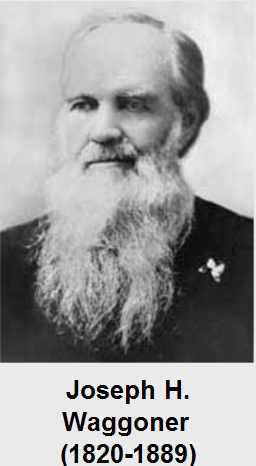
Though a man with little formal education, J. H. Waggoner was a giant in literary accomplishments, a master of Greek and Hebrew, a knowledgeable theologian, an accomplished editor, a pioneer in health reform and religious liberty, and a tower of strength as a pioneer in the closing message of truth.
When Waggoner first learned of the Adventist message in December, 1851, he was editor and publisher of a political newspaper. Evidently Waggoner doubted that he could be saved because he had not been in ‘the 1844 movement’. Ellen White encouraged him to hope in God and to give his heart fully to Jesus, which he did then early in 1852. He threw his tobacco wad into the stove on the day he accepted the Sabbath, and he stood with Joseph Bates as a strong advocate of temperate living.
By 1853, Waggoner had unreservedly dedicated his life to the propagation of the message. Having learned the publishing trade as a youth in Pennsylvania and Illinois, Waggoner’s talents were employed many times in editorial capacities. He followed James White as editor of the western Signs of the Times, and he was the first editor of both the Pacific Health Journal and the American Sentinel (a Religious Liberty journal).
(Vol. 4, No. 4 of "Lest We Forget" features J. H. Waggoner.)